
Global emerging market investors are sharply cutting back on India, making it the largest underweight market, as funds rotate into China, Hong Kong, and South Korea amid tariff shocks and valuation concerns.

Investors would track a host of macroeconomic data announcements scheduled this week, including inflation numbers, and also monitor global market trends, and trading activity of foreign institutional investors, analysts said. The ongoing quarterly earnings announcements and the rupee-dollar trend would also influence the markets.

India's $280-billion IT industry heads into 2026, balancing visa-related headwinds and global trade uncertainty against its biggest-ever push into artificial intelligence and the rapid expansion of global capability centres (GCCs). Heightened scrutiny of the US H-1B visa programme - including a proposed $100,000 fee for new visas and concerns over a potential 25 per cent outsourcing tax - has complicated cross-border delivery for Indian firms, even as companies accelerate efforts to reduce reliance on onsite staffing.

The equity benchmark indices posted their strongest weekly gains in years, driven by bargain hunting and optimism over a reversal in foreign portfolio investor (FPI) outflows. The Sensex rose 558 points, or 0.7 per cent, on Friday to close at 76,906, while the Nifty 50 gained 160 points to end at 23,350. Over the past five sessions, both indices advanced around 4.3 per cent - marking the Sensex's best weekly performance since July 22, 2022, and the Nifty 50's strongest rally since February 5, 2021.

India's labour market in the second quarter (July-September/Q2) of 2025-26 (FY26) showed resilience, with the jobless rate easing even as more people entered the workforce. However, a rise in youth unemployment and a fall in the share of salaried workers remain areas of concern.

With the rise of digital classrooms, students are often asked to create videos, prepare slideshows or use online research to complete assignments. 'We are glad that children are not spending hours copying notes in the name of homework but even now parents end up doing or supporting a major portion of the homework.'

Indian equity benchmarks rose nearly 2 per cent on Thursday, capping a truncated trading week with their strongest weekly performance in over four years. The rally was sparked by renewed risk-on sentiment following progress in trade negotiations and expanded tariff exemptions.

'Things may get much worse before they get better,' predicts Ajay Chhibber.

India has revised its proposal to impose retaliatory duties under the WTO (World Trade Organisation) norms against the US over American tariffs on steel and aluminium in view of the further hike in duty by the Trump administration. The US first imposed 25 per cent tariffs on imports of aluminium, steel and derivative articles on March 12.

OpenAI will provide 500,000 free ChatGPT licences for six months to students and teachers across government schools from classes 1 to 12, engineering and technical institutes, as well as K-12 educators.

Market experts say India's IPO ecosystem has matured to support both primary and secondary issuance, rendering the mix less consequential.

'Are there other ways to reduce the energy airconditioners consume?' asks Ambi Parameswaran.
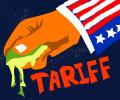
The US is "pretty close" to reaching a "fair trade deal" with India, President Donald Trump has said, adding that he will lower the tariffs imposed on Indian goods at "some point".

'From every point of view, they have faced an extremely difficult couple of years, and the setback they have suffered is irreversible.' 'This reality has begun to set in even amongst the top-level cadres. That is why, in recent times, we have witnessed a huge number of senior-level cadres emerging from the jungle and deciding to renounce violence and join the mainstream.'

'When you finally hold that red bag with your personalised Onitsukas inside, it feels like ticking off a very satisfying item on your travel checklist,' discovers Mayur Sanap after visiting Onitsuka Tiger's famous Red Concept store in Tokyo.

A US bankruptcy court has reversed a $1 billion damages ruling against Byju Raveendran, according to a statement from the founders of Think and Learn Pvt Ltd - the parent firm of ed-tech platform Byju's.

Russia has a "special mechanism" to confront any challenge arising out of the US slapping punitive measures against India for its procurement of Russian crude oil, Russian charge d'affaires Roman Babushkin said on Wednesday.

'Calibrated depreciation will help rebalance external fundamentals, offset some of the tariff differentials with competitors, improve the competitiveness of domestic substitutes vis-a-vis Chinese imports, and contribute to the easing of financial conditions at a time when the inflation rate is unusually low,' explains Sajjid Z Chinoy, head of Asia Economics at JP Morgan.

Zomato was not just recovering, it was rebuilding and reinventing, showing signs of maturing as a business. Chaos had been turned into momentum. A fascinating excerpt from Megha Vishwanath's book, UNSEEN: The Untold Story of Deepinder Goyal And The Making Of Zomato.

'The aim is to have curated datasets that create cultural and historical nuances that help us make our models understand these better.'

'We are seeing a lot of people with helmets visiting our showrooms.'

The technology major confirmed that a 'low single-digit percentage' of its 270,000 employees would be affected in the fourth quarter of 2025.

'When AI comes in, coders in Bangalore or Hyderabad will lose their jobs.'

The Federation of Indian Chambers of Commerce and Industry (Ficci) has sought urgent steps to clear the huge backlog of income-tax appeals, simplify tax deducted at source (TDS) compliance, and ensure tax neutrality for fast-track demergers, during its consultation with Revenue Secretary Arvind Shrivastava ahead of the Union Budget 2026-27.

Communication channels between India and the US are open to resolve the ongoing tariff issues, and the glitch in trade ties is only temporary, given the long-term relationship between the two nations, government sources said on Wednesday. The US' 50 per cent tariffs on Indian exports to America came into effect from August 27, barring a few sectors.

Investors will take cues from the December quarter corporate earnings, with blue-chips like Infosys, Reliance Industries scheduled to report their results this week, in addition, inflation data and trading activity of foreign investors will also be crucial in dictating market trends, analysts said.
RBI's interest rate decision, quarterly earnings and global cues would be the major driving factors for equity markets this week, analysts said adding that the impact of the Union Budget could linger on this week. Trading activity of foreign investors will also be a key driver for the markets, experts noted. "US and India's manufacturing PMI for January to be released on Monday, will be the key macro data to watch out for.

A new report indicates a significant rise in reported sexual offences against children in India, but also highlights strong prosecution rates and detection systems.

In the June 16 advisory, the US urged its citizens to exercise "increased caution" due to crime and rape, and advised them not to travel to certain parts of central and eastern parts of the country due to terrorism.

The Supreme Court expressed serious concern over custodial deaths, calling it a 'blot' on the system. The court is pushing for compliance with orders to install CCTV cameras in police stations and central investigation agencies to curb human rights abuses.

Retirement fund body EPFO has extended the deadline for filing EPF return or ECR (electronic challan-cum-return) by one week for the wage month of September till October 22, 2025. The employers are mandated to file the ECR by the 15th of every month.

Macroeconomic data announcements, trading activity of foreign investors and global trends will guide equity market movement this week, which would also mark the beginning of the new calendar year and month, analysts said.

Trading sentiment in the equity market this week will be guided by global trends, foreign fund movement, macroeconomic data announcements and RBI's interest rate decision, analysts said. The monthly auto sales data announcement would also be tracked by investors this week.

India's top listed real estate developers - DLF, Lodha Group, Prestige Estates, and Oberoi Realty, excluding Godrej Properties - reported strong presales growth in the first quarter (Q1) of 2025-26 (FY26), even as earnings showed a mixed trend. According to Nomura, the top five developers - DLF, Lodha, Prestige, Oberoi, and Godrej - recorded a cumulative 59 per cent year-on-year (Y-o-Y) growth in presales.

India's forex reserves increased by $1.57 billion to $677.83 billion for the week ended April 11, the Reserve Bank said on Friday. This is the sixth consecutive week of a rise in the kitty.

Hugely creative with a very evolved aesthetic sense, he made the Illustrated Weekly of India every young reporter's dream. Payal Singh Mohanka remembers Pritish Nandy who passed into the ages on January 8, 2025.

Investors' sentiments will be guided by a host of domestic and global macroeconomic data announcements this week, along with the trading activity of foreign investors and trends in world stocks, analysts said. Besides, the rupee-dollar trend and movement of global oil benchmark Brent crude will also be crucial in dictating terms in the market, experts added.

The comments came a day after US President Donald Trump said that Washington is "very close" to the trade pact with India.

The government will introduce a new Income Tax bill next week to take forward the "trust first, scrutinise later" concept, Finance Minister Nirmala Sitharaman said on Saturday. In another major reform move, the minister announced that the Foreign Direct Investment (FDI) in the insurance sector will be increased to 100 per cent from 74 per cent.

The US's recent 50 per cent tariff on Indian exports will have a trickledown effect on India's affordable housing, potentially derailing demand as well as supply in this segment, according to experts. Pointing to worker incomes and jobs in micro, small and medium enterprises (MSMEs), and small and medium enterprises (SMEs) that typically make up majority of the customer base of affordable housing, would take a hit in the near terms due to the tariff change, further crippling India's affordable housing sector, already reeling from the impact of the Covid-19 pandemic.
